


A Black lay leader, relatively new to her congregation, clapped after a choir anthem. It lasted a second. A white deacon went to the church’s leadership to report that her clapping had disrupted the worship atmosphere, and word eventually reached her.
“I don’t know what to do in church anymore,” she told our research team.
Nothing in that exchange required anyone to hold a racist belief. The deacon was defending what he experienced as reverence. The congregation understands itself as welcoming. The pastor preaches justice. But a woman who was present enough to respond with her body learned that her body had become a problem to be managed.
I have spent the past five years studying white progressive congregations in the United States and Canada, work that will appear next year in Aspiring to Antiracism with Mark Mulder and Kevin Dougherty (pre-order available). In a new article for Liturgy, I have tried to name the pattern that kept surfacing in that fieldwork. I call it the lull of liturgy, a condition in which devotional practice produces moral satisfaction while deferring the sustained, disruptive labor that dismantling racism actually requires.
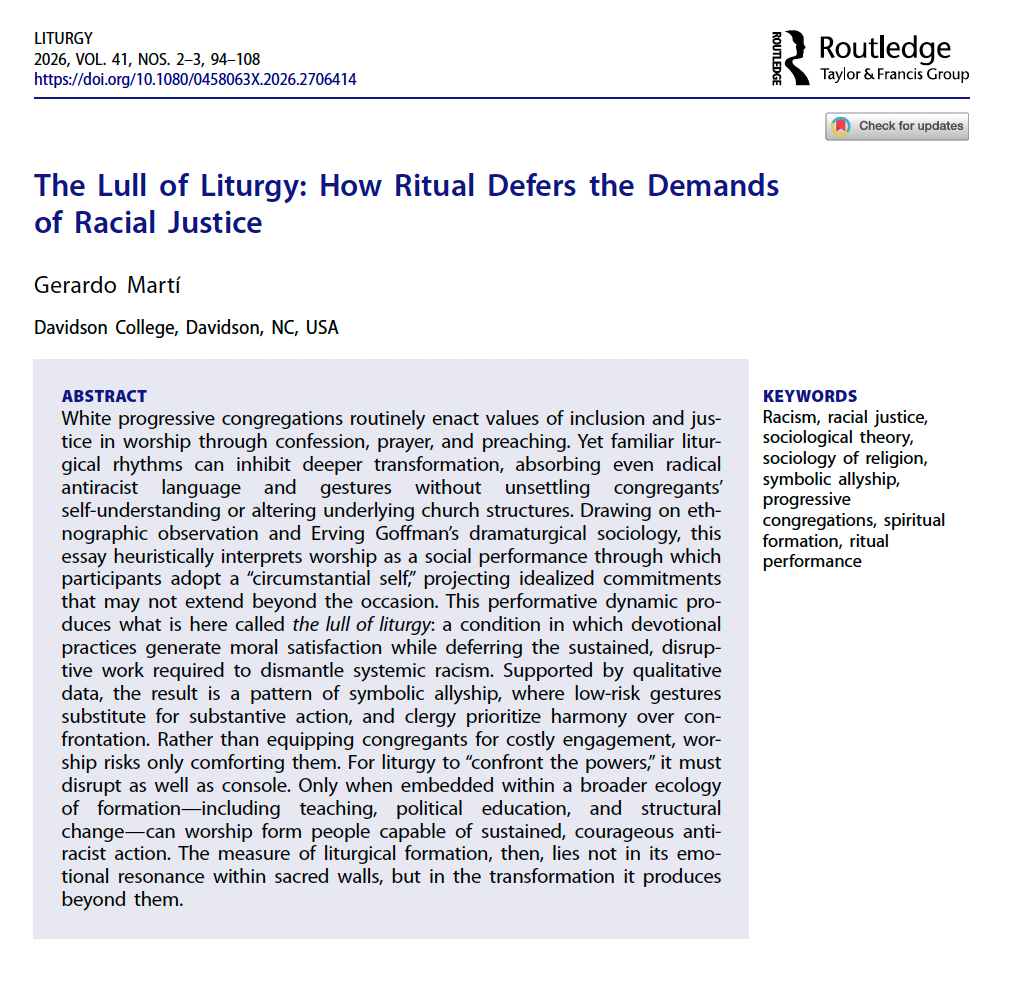
Our forthcoming book was already largely written, so the ideas in this article are entirely new, a fresh approach to the challenge of racial justice in a changing church.
The lull works most effectively in congregations convinced the work is already underway.
The Lull of Liturgy in Congregational Life
Consider how often the absorption happens through generosity rather than resistance.
One congregation dedicated an entire Sunday service to African American spirituals. A white worship leader directed the music. No musicians of color were invited to help lead it. Members noticed before the leadership did. Another church incorporated Black voices by scheduling a children’s book about an enslaved person during the standard Children’s Time, a heartwarming story that spoke of empowerment but moved past the racial brutality that forced the condition requiring intervention. Both congregations did something connected to racial justice. Both did it in a way that neatly fit into the rhythm, tone, and power arrangements nested in the sanctuary.
Resistance arrives when the racial justice is seen as disrupting personal worship. In a Massachusetts church, members pushed back against increased attention to racial injustice by insisting that Sunday is a day of rest meant for peaceful and nice commentaries about God. A lay leader in a Southern congregation calculated his pastor’s preaching at eighty percent social justice and twenty percent comfort and encouragement, then proposed reversing the ratio, saying that messages from the pulpit should be 80% encouragement.
When a North Carolina congregation conducted a worship audit to explore whether livelier music might draw a more diverse body, members defended their contemplative service with real fervor. In other churches, the anxiety surfaced more directly, with accusations that leaders were trying to make them into “a Black church.”
Pastors know racial justice can provoke disruption. One white minister admitted he avoids all of “the really hard parts” of preaching on racism because congregants expect sermons to be largely uplifting. Another described antiracist work as “a difficult dance, a real difficult dance.” A third defended the softness of his messages as strategy, “a long game,” keeping people “close enough that they do not mistake us for the enemy.” That may be wise. It may also be how a congregation spends two decades not arriving anywhere. As he and other pastors admit, “we haven’t made much progress.”
These are congregations that affirm racial justice. Research cited in this new article shows that church attendance among white Christians has become a reliable predictor of resistance to racial equity. Progressive congregations are a small and symbolically significant exception operating inside that pressure, but other research reveals that the majority of supposedly progressive publications are progressive in the pulpit but conservative in the pew.
Why Worship Absorbs What It Proclaims
The theoretical work of sociologist Erving Goffman describes how people in every social setting manage impressions and sustain a shared definition of the situation. Worship is no exception, and full participation intensifies the dynamic rather than dissolving it: the more completely a worshiping assembly inhabits its liturgical roles, the more powerfully it generates a shared moral environment, and the more consequential the question of what happens to that environment when the assembly dissipates.
Inside the sanctuary, worshipers project what I call in this new article “a circumstantial self,” a morally charged identity with idealized commitments to justice and solidarity that the liturgical form itself scaffolds. Music aligns feeling. Scripts organize speech. Bodies gather and orient in common. The moral intensity is real. But the intensity is held up by conditions that are withdrawn after the benediction.
Goffman’s sharpest observation is that performers are concerned less with realizing a standard than with producing a convincing impression that the standard is being realized. He called such people “merchants of morality,” noting that the more attention we give to the goods we display, the more distant we feel from them.
This is not about hypocrisy. It describes how all of us inhabit different moral registers in different rooms. The question is not whether worship forms people. It does. The question is whether congregations have built structures that carry those commitments past the parking lot. In the churches I studied, they largely have not.
Three things sustain the gap between what happens in worship and what happens out in the world. The implicit curriculum of whiteness, as HyeRan Kim-Cragg names it, runs through hymns that map whiteness onto spiritual cleansing and lectionary cycles that season after season set light against darkness. Alongside it runs a null curriculum, the organized forgetting of colonization, slavery, and dispossession. And organizational loose coupling lets formal commitments float free of daily practice, so that policies change on paper while decision-making does not.
The result is a façade of solidarity on antiracism that has little connection to what members actually do beyond the service—even what the church itself may do beyond it’s own liturgical moments. One white congregant summarized the prevailing view among longtime members with unusual candor: “People of color need to embrace us, instead of the other way around.”
What Thriving Actually Requires
Congregations tend to operate based on identity and belonging more than on doctrine. Which is why the lull matters so much. When a congregation’s belonging is built around aesthetic comfort, the people who disturb that comfort learn their status is provisional. Elijah Anderson’s concept of white space describes it well, an environment where Black members move carefully and demonstrate they will not upset the established order. Jelani Ince’s research on the diversity demeanor documents the labor involved, a practiced patience and a constant management of other people’s discomfort.
That labor is a retention problem before it is a moral one. The woman who no longer knows what to do in church will eventually stop doing anything in church. Korie Little Edwards and Rebecca Kim have shown how heavily this falls on clergy of color leading multiethnic congregations, who carry the institutional weight while navigating the resistance.
A white congregation that cannot survive a clap from a Black member has not built the capacity to survive racial differences that are any larger.
What Leaders Can Do
Start by noticing what worship refuses to absorb. When a Kentucky church confronted stained-glass windows honoring the enslavers who founded it, the liturgy could not return to its comfortable baseline. When a Texas congregation formally commemorated an African American janitor who had been barred from worship in the sanctuary he served for decades, the same thing happened. Those moments are diagnostic. They reveal what the shared performance had been quietly sustaining.
Then build the three dimensions that hold formation toward racial justice together. The catechetical work reverses the null curriculum through sustained teaching that treats white Christian complicity as a continuing inheritance rather than distant background. The relational work creates cross-racial accountability that moves the burden of racial accommodation onto the white congregants who have long evaded it. The structural work of redistributing budget authority, decision-making power, and use of physical space to non-white members, lay leaders, and pastors brings in considerations that have been long ignored. Any one of these alone gets absorbed. Together they resist absorption.
Pair liturgical moments with continuing practices. Confession with reparative action. The passing of the peace with advocacy on housing or schools. Eucharist as a summons to redistribution rather than a symbol of shared feeling. Donna Haraway’s phrase is the right instruction for congregational leaders here, to stay with the trouble rather than resolve it on schedule.
And change the measure that is accepted for success in racial justice. The test of formation is not the emotional resonance of Sunday morning. It is whether anything still holds on Monday afternoon, in the workplace, the budget meeting, and the neighborhood. A congregation that experiences justice as liturgy but not as policy, budget, or risk has not yet begun the work its worship describes.
The lull of liturgy may be encouraging, even stimulating. The question is whether actions move beyond the sanctuary.
Available for Preorder Now
Aspiring to Antiracism is available for preorder now on the Oxford University Press website. Order now and receive the book as soon as it publishes in 2027.
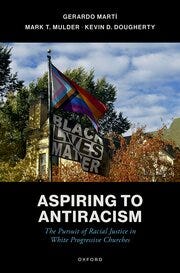
Gerardo Martí is William R. Kenan, Jr. Professor of Sociology at Davidson College and past president of the Society for the Scientific Study of Religion and the Association for the Sociology of Religion. He is an award-winning researcher and author or co-author of ten books on themes of race, religion, power, and social change. His most recent book, The Church Must Grow or Perish: Robert H. Schuller and the Business of American Christianity, is available from Wm. B. Eerdmans Publishing Co. And, soon to come: Aspiring to Antiracism: The Pursuit of Racial Justice in White Progressive Churches, co-written with Mark T. Mulder and Kevin Dougherty, published by Oxford University Press (2027).
Join me on Bluesky