


The Spanish phrase bajo palio—under the sacred canopy—carries profound religious and political significance. When Francisco Franco walked bajo palio [BAH-hoh PAH-lyoh], meaning beneath the processional canopy, into Madrid’s Church of Santa Barbara following his 1939 victory, he did more than attend a religious rite. He appropriated a symbol of divine protection, refashioning the palio into a mobile organ of state power.
A Sacred Shelter on the Move
The palio or processional canopy represents one of Catholicism’s most venerable liturgical traditions. This mobile fabric covering, supported by poles and carried by designated bearers, serves to honor and protect the most sacred elements of Catholic worship. In Catholic ritual, the palio is not a static object. It is a canopy designed to move. Traditionally employed during Corpus Christi processions, the canopy shelters the Eucharist—the body of Christ—as it moves through public spaces, creating a portable sanctuary that extends the sacred realm beyond church walls
Unlike a fixed altar, the steps of the one beneath shape what is covered and consecrated.
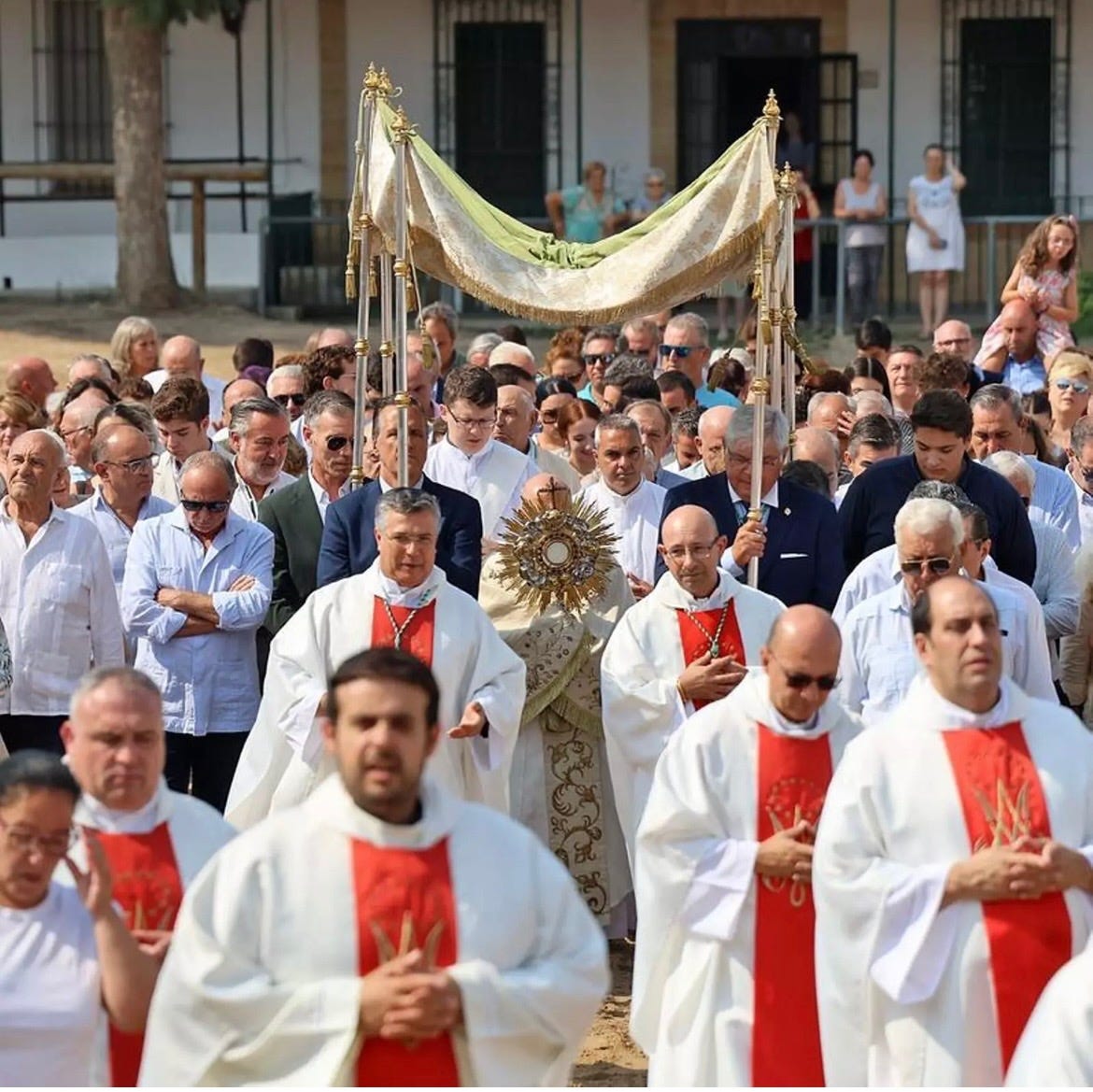
This mobility is what renders the palio unique among sacred symbols. It conveys holiness wherever it goes, transforming streets into sanctuaries as the consecrated Host passes by. It evokes the Tabernacle carried by ancient Israel—movement results not from divine prompting but the will of the leader beneath.
The palio allows the person beneath to determine direction. The sacred covering synchronizes with the walker, ensuring that wherever the person goes, they remains enveloped in sanctity. Those carrying the canopy adjust their steps to match. The canopy thus grants immense symbolic power to its occupant: their will defines the path, and the church’s most visible sign of holiness moves with them, affirming that path as legitimate, even divinely chosen.
Ordinarily, this privilege is reserved for the Blessed Sacrament itself, borne in a monstrance. But in Twentieth-century Spain, one man—Francisco Franco—walked beneath the canopy. The consequences of that concession continue to resonate today.
The Meaning of Bajo Palio
To be seen walking bajo palio—“under the canopy”—is to inhabit a zone of consecration. In Catholic practice, only the Blessed Sacrament is entitled to such a covering. The canopy hovers above the Host, shielding and honoring the Real Presence as it moves in procession. The symbolism is precise: Christ is not stationary, confined to the altar, but is on the move among his people. The canopy transforms ordinary space into liturgical space, even outside the church walls.
In Corpus Christi processions, the canopy signaled reverence and protection for the Real Presence. Its extension to monarchs was rare, signaling that their sovereignty itself participated in divine ordering. When Franco first received this honor in May 1939, as he entered Madrid’s church of Santa Bárbara in a solemn thanksgiving after victory, the gesture spoke volumes.
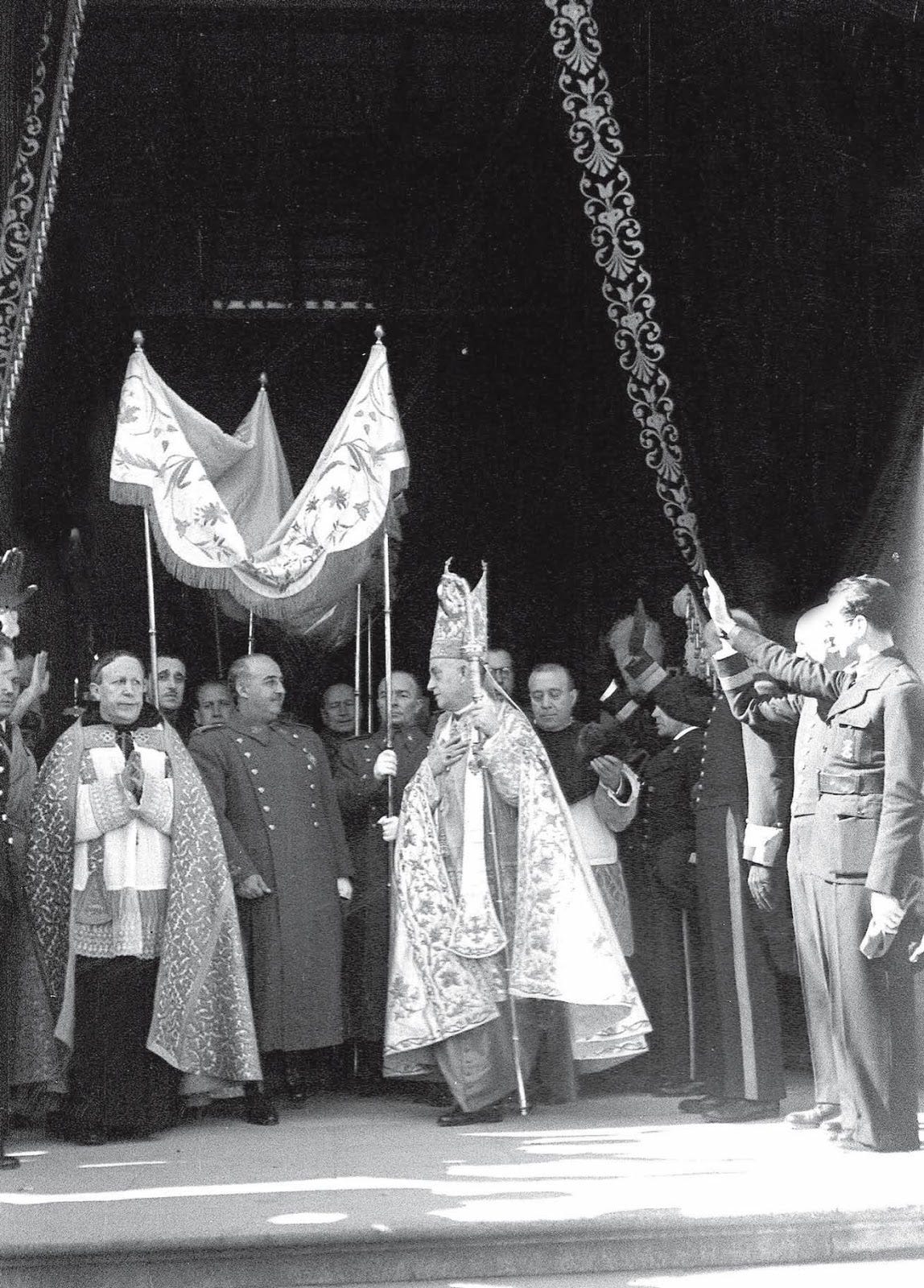
To extend this privilege to a political leader is extraordinary. The act renders his presence equivalent to the Eucharist, his body treated as worthy of the same mobile sanctification that belongs to Christ. And because the canopy is portable, its symbolism suggests that wherever he goes, he remains covered, his authority wrapped in holiness.
Franco Beneath the Canopy
The white silk canopy that covered Francisco Franco as he entered Santa Barbara repurposed a sacred symbol to cloak temporal authority in divine legitimacy. After the Spanish Civil War (1936–1939), Franco consolidated his rule through a fusion of military power, nationalist ideology, and Catholic allegiance. His regime, marked by repression and censorship, presented itself as both savior of the nation and defender of the faith.
Franco positioned himself as guardian of Catholic unity against secularism, socialism, and Protestant “heresy.” He fused military rule and Catholic unity. The Catholic hierarchy hailed him as the chosen instrument of God’s providence, the restorer of Christian order. The regime institutionalized this alliance through what became known as “National Catholicism.” Walking beneath the canopy dramatized this arrangement. Franco’s public appearances emphasized his role as defender of Catholic Spain. Franco strode under embroidered cloth, held aloft by attendants, while clergy flanked his steps. The canopy shifted with his movement. His path, literally, was made holy.
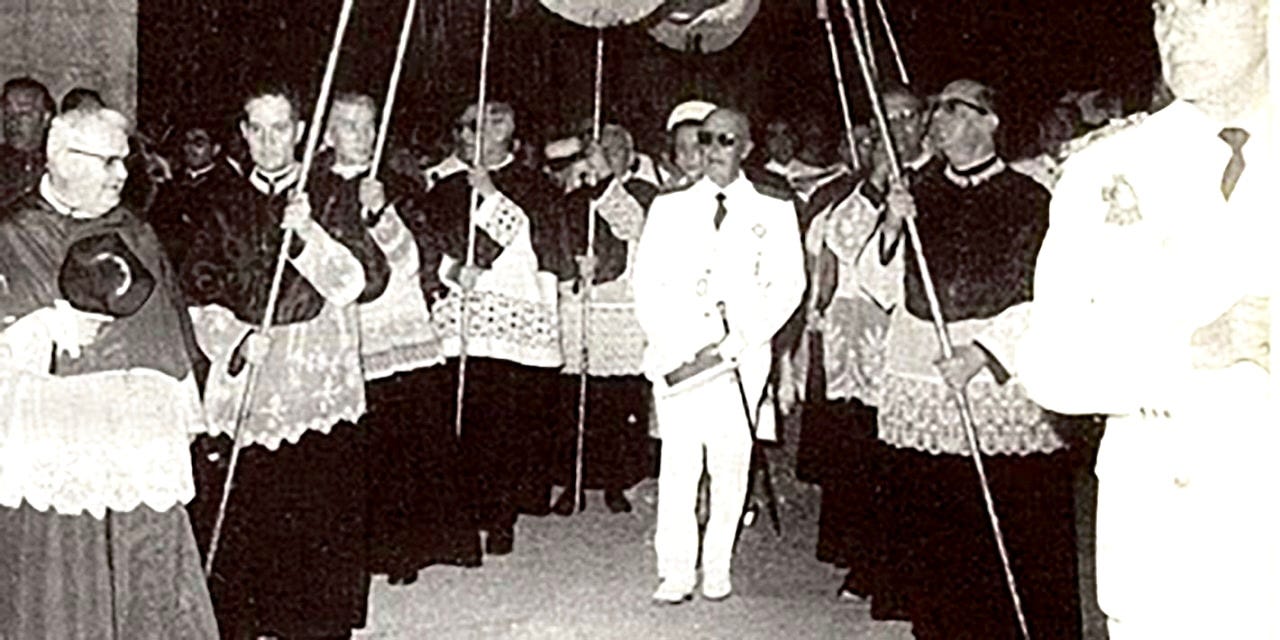
The canopy followed his will. So did a nation.
Franco’s Spain became a model of sacralized authoritarianism. The cross and the sword were not only allied in ceremony but entwined in governance. Franco ruled beneath the canopy; Spain itself was stretched beneath it. The regime’s motto—“Una, Grande, Libre” (One, Great, Free)—echoed religious language while the state’s official ideology explicitly linked Spanish identity to Catholic faith. Religious orders gained control of education. Censorship boards operated with ecclesial oversight. The regime lavished subsidies on clerical projects, while groups such as Opus Dei gained prominence in administration and finance (Preston 2019).
In his movements, Franco’s power was not confined to palace or parliament; wherever he went, the church’s covering went with him. His political direction—whether suppressing dissent, centralizing authority, or exalting Spanish nationalism—was given the aura of divine approval. The canopy signaled that the Church would keep pace—following, not leading; hallowing, not holding to account.
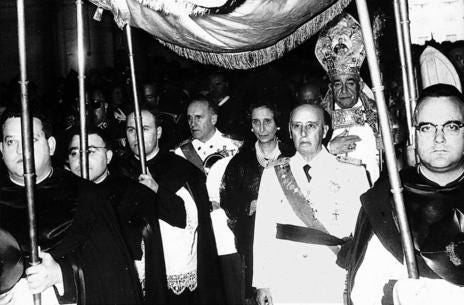
Bajo palio, what had once announced Christ’s presence now marked Franco’s. The symbol of divine accompaniment became the instrument of authoritarian legitimacy. The canopy’s portability—its ability to sacralize motion, not merely space—made it a flexible device for the changing whims of a dictator who was forwarded as a quasi-sacramental figure.
The church’s complicity in Franco’s canopy-walk cannot be dismissed as an innocent ritual. When the palio sheltered Franco, the Church transposed Christ’s signifier onto a mortal ruler, shrouding his authority in ritual holiness that moved with him, step by step, throughout public life. The gesture signaled not only endorsement but subordination: the sacred cover adjusted to Franco’s steps, not the other way around. By conceding bajo palio to a political leader, the Catholic hierarchy demonstrated its willingness to yoke the sacred to the State.
The result was what scholars term nacionalcatolicismo: the fusion of political power with Catholic orthodoxy (Payne 1987). Religious dictates saturated public institutions. Education, law, censorship, marriage, and morality were placed under ecclesial authority. Franco’s own visage appeared on coins with the legend, “Francisco Franco, Caudillo de España por la gracia de Dios” [Francisco Franco, Leader of Spain by the grace of God]. The message was inescapable: dictatorship sanctified.
The Vatican formalized the arrangement in the 1953 Concordat, granting the Spanish Church vast privileges—control of schools, censorship, exemptions, and generous subsidies—in return for loyalty. Internationally, the Concordat provided Franco’s regime with desperately needed legitimacy after years of isolation—a privilege not accorded even to Hitler or Mussolini (Callahan 2000). Pius XII himself praised Franco, describing him as a defender of Christian civilization, and conferred on him the collar of the Papal Order of Christ (Diario de Mallorca). The dictator was now garbed as a Catholic sovereign.
Politics Bajo Palio
Franco illustrates a broader truth about the relationship between sacred symbols and political power. Just as the canopy moved with Franco’s body, so the church moved with Franco’s politics. His steps set the rhythm, and the institution kept pace. The church was not directing, guiding, or moderating the leader; it was following him, covering him, hallowing his path.
Fixed altars may be used to bless leaders in specific spaces or ceremonies—and in order to participate in the event, the leader must go to them. But a canopy moves. It adapts to the leader’s path, extending holiness wherever he treads. This portability shifts agency: the leader sets direction, the symbol affirms it.
In contemporary politics, literal canopies are rare. But the logic of bajo palio remains. Religious communities extend mobile sanctification to leaders by providing unbroken legitimation, accompanying them through controversies, scandals, and abuses of power. Instead of tethering sacred direction to Christ alone, they tether it to the movements of a person—a powerful man.
Today, no American president has literally walked bajo palio, but the metaphor fits. White conservative Christians have shadowed Donald Trump across each transgression, supplying not just votes but a steady canopy of religious language and assurance. Metaphorically, they have carry a canopy for him. Despite Trump’s personal failings and un-Christian behavior, white Christians have consistently supported him. From 2016 through his first presidency and beyond, a broad swath of evangelical and conservative Protestant communities have ensured that wherever Trump walks—into nativist rhetoric, anti-democratic maneuvers, or incendiary grievance politics—he remains covered by religious legitimation. In return, Trump promises to protect his “beautiful Christians” from perceived persecution, echoing Franco’s role as defender of Catholic Spain.
The canopy in this case is woven not of fabric but of sermons, prayers, and public declarations—including social media posts and talking head commentary. Pastors proclaim Trump as God’s chosen leader. “Court prophets” anointed him in the Oval Office. Evangelical leaders excused his behavior as divinely instrumental, insisting that God uses flawed vessels. The Jericho March surrounded Washington, D.C., in prayerful defense of his cause. In each case, the sacred cover does not precede him; it follows him. The sacred covering moves wherever the leader turns—a choreography mirrored in the Francoist procession.
The crucial point is mobility.
Religious legitimation did not remain in one ceremonial space—say, an inaugural prayer. It accompanied Trump into every context: campaign rallies, court battles, Truth Social tirades. Like Franco under the canopy, Trump set the direction, and religious supporters ensured the covering adjusted to his steps. He was never left exposed. The canopy synchronized with his movement, granting each turn the aura of divine approval.
This dynamic reveals how a sacred canopy that follows a leader grants immense symbolic power. His direction becomes sanctified because the canopy accompanies it. The leader’s will, rather than God’s or the church’s, sets the path of divine cover.
Franco’s four-decade dictatorship demonstrates the durability of religiously legitimized authoritarianism. Franco embodied this danger in literal form, walking beneath the palio once reserved for Christ. Trump exemplifies this in a metaphorical form, receiving continuous religious legitimation from communities unwilling to withdraw their canopy of approval. In both cases, the portability of the sacred covering transforms it from a sign of divine presence into an instrument of political power.
Reclaiming the Canopy from the Strongman
The photographs of Franco under the canopy endure as stark reminders. A dictator walked where only the Eucharist should walk. Clerics adjusted their steps to his. Sacred cloth swayed above his head, shielding his power as holy. The canopy moved with him, wherever he chose to go.
Yet, in a thread on Bluesky, Dean Dettloff wrote, “Indeed the church was very complicit in Franco's fascism, but it's also essential to recall important sectors of the church were militantly opposed to Francoism, such that "the church" is not a very reliable category for identifying an actor. Not to excuse Catholicism, but to complicate it.”

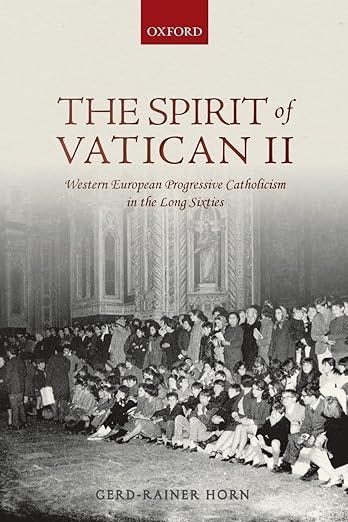
Dettloff references Gerd-Rainer Horn’s book The Spirit of Vatican II to reveal the intervention of “dissident local priests” of the Spanish New Left who resisted Franco’s repression: “What's important about this and other studies is that it shows Catholicism isn't *only* a cover for the most reactionary regimes (although it so often is clearly and disproportionately exactly that!), but is a site of struggle and antagonisms itself.”
Detloff concludes his thread, saying, “absolutely the church was a major piece of the aura enabling fascism in Spain. But the church was also a major piece for breaking fascism in Spain. The same holds in so many other contexts, and highlights how important it is to tell a complicated story about faith and politics”
The lesson is clear: To resist politics bajo palio requires refusing to let the sacred follow power uncritically. It requires the courage to withhold sanctification when power diverges from justice. It demands fidelity not to the steps of a ruler but to the One whom the canopy was designed to honor.
America’s present rhymes with Spain’s past. Our current president has not walked yet under a literal canopy, but the logic of bajo palio—sacred cover moving in sync with the leader—has marked his relationship with religious supporters. The danger lies in the portability itself. When holiness follows the strongman, his will becomes indistinguishable from divine will. His path becomes sanctified simply because the canopy keeps pace.
The palio’s apparent strength—its mobility—allows it to easily rearranges itself to sanctify the movements of power.
The question is whether communities of faith will continue to adjust their steps to follow rulers, or reclaim the canopy for its rightful purpose: to signify Christ’s presence, not sanctify the ambitions of power. Once religious authority adjusts its steps to those in power, both faith and democracy suffer irreparable damage.
So, although repression occurred in Spain, so did resistance—both locally and organizationally. And as Gerd-Rainer Horn richly illustrates, the church can creatively engage new ideas and new forms to support new initiatives to disrupt the too-usual relations between religion and political power.
Join me on Bluesky
If you just want to buy me a quick cup of coffee…
Even small support is appreciated — Buy me a cup of coffee!